Skip to content

Clinical Neuroradiology

Precision tools for the interpreting mind

Central Sulcus provides clinical neuroradiology tools, structured reporting aids, and educational resources built for the complexity of modern neuroimaging.

10
Clinical Tools
HTTPS
Secure Access
100%
Browser-Based
Free
No Login Required

Web tools, ready to use

Each tool runs entirely in your browser — no login, no installation, no data leaves your device. Designed for clinical use, accessible from any hospital computer.

Head & Neck TNM Staging
Structured TNM staging reference for head and neck malignancies — oral cavity, oropharynx, hypopharynx, larynx, and thyroid. AJCC 8th edition.
Oncology
Open
Structured Reporting Templates
Structured Reporting Templates — Coming Soon. Currently in development.
Coming Soon
ASPECTS Score Calculator
Alberta Stroke Program Early CT Score. Systematic 10-point assessment of early ischemic changes in the MCA territory for acute stroke triage.
Stroke
Open
MRI Protocol Tool V2
Body-system and indication-based MRI protocol selector. Covers brain, spine, MSK, body, and vascular. Internal access required.
Internal
Access Required
IR Sequence Simulator
Interactive inversion recovery MRI physics simulator. Model TI, TR, and T1 values to visualize signal nulling and tissue contrast behavior.
MRI Physics Open
MRI Protein Signal Tool
Protein concentration and T1/T2 signal behavior reference. Understand how protein content affects MRI signal intensity across sequences.
MRI Physics Open
Hyperperfusion, Hypervascularity & Enhancement
Conceptual and diagnostic reference distinguishing hyperperfusion, hypervascularity, and enhancement on MRI and CT.
Perfusion Open
Resident Education Modules
Interactive neuroimaging teaching cases and reference handouts for radiology residents. Coming soon.
Coming Soon

Reference documents & files

Clinical reference PDFs and working files. Password-protected sections require internal access.

Clinical Reference Documents
AJCC 8th Edition — H&N Staging Quick Reference
Nodal Level Classification — Imaging Reference
Scoliosis Plain Film Measurement Tutorial & PowerScribe Macros

Built for clinical use

Design Principles
  • Accessible from any hospital network over HTTPS
  • No patient data entered or stored
  • No login or account required
  • Works on desktop, tablet, and mobile
  • Built around AJCC, ACR, and society guidelines
  • Optimized for speed — minimal load time

The Central Sulcus

The central sulcus — the landmark fissure dividing the frontal and parietal lobes — sits at the boundary between motor output and sensory processing. It is one of the most reliably identified structures in neuroimaging, and one of the most important to get right.

This site takes its name from that landmark. The tools here are built around the same idea: clear boundaries, reliable structure, and precision in the details that matter.

Each tool was developed from real clinical workflows — tumor board tracking, structured reporting, imaging protocol selection — and refined for the way radiologists actually work. Every tool runs entirely in the browser; no data is transmitted or stored.

Key neuroanatomy landmarks

Sagittal brain anatomy most relevant to neuroimaging interpretation.
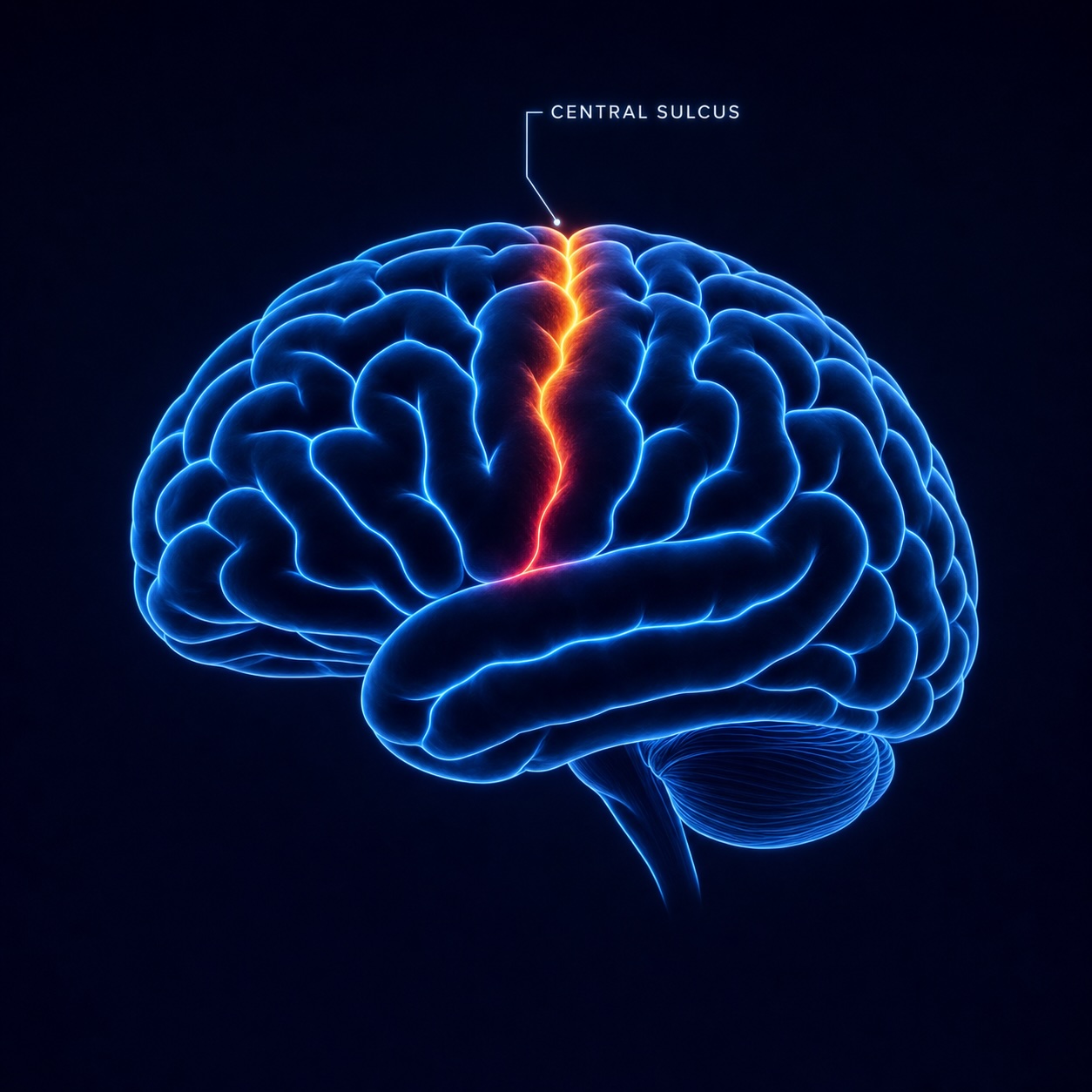
Central Sulcus neuroimaging illustration
Central Sulcus
The primary landmark dividing the precentral gyrus (primary motor cortex, Brodmann area 4) from the postcentral gyrus (primary somatosensory cortex, areas 3, 1, 2). Reliably identified on sagittal MRI by the hand knob ("omega sign") at the dorsal convexity.
Precentral Gyrus
Anterior to the central sulcus. Primary motor cortex. Loss of gray-white differentiation on DWI indicates acute cortical infarct; restricted diffusion without swelling distinguishes acute from chronic.
Corpus Callosum
The major white matter commissure connecting hemispheres. Key for detecting callosal dysgenesis, demyelination (MS), and "butterfly" glioblastoma crossing the midline via the splenium or body.
Sylvian Fissure
Lateral sulcus separating the temporal lobe from frontal and parietal lobes. Asymmetric enlargement raises concern for prior injury, atrophy, or mass effect displacing the fissure.